Shem and Shaun’s brotherhood
Finnegans WakeShem and Shaun’s brotherhood joins family identity to division: they are named as the sons of Anna Livia and Humphrey Chimpden Earwicker, but also as a pair whose difference produces shame and conflict. Across questioning, rumor, song, and symbolic formula, their kinship recurs as both a fact of descent and an unstable opposition.
Identity and Family
The text asks who the children of Anna Livia are, then presses the question into the names of John and Shaun and of Shem and Shaun. Its wavering sequence—sons or daughters, one named pair or another—makes family identity feel less like a fixed register than a story repeatedly sought in the surrounding waters. The brothers are nevertheless identified as the living offspring of Anna Livia and Humphrey Chimpden Earwicker, placing their relationship at the center of the family’s generational pattern.
That pattern is linked to repetition and change. A passage describing the parents’ marriage turns through the formula “Anna was, Livia is, Plurabelle’s to be,” setting past, present, and future beside one another. The children belong to a household imagined as recurring across time, even as the text keeps altering the terms in which its members can be named.
Rivalry and Division
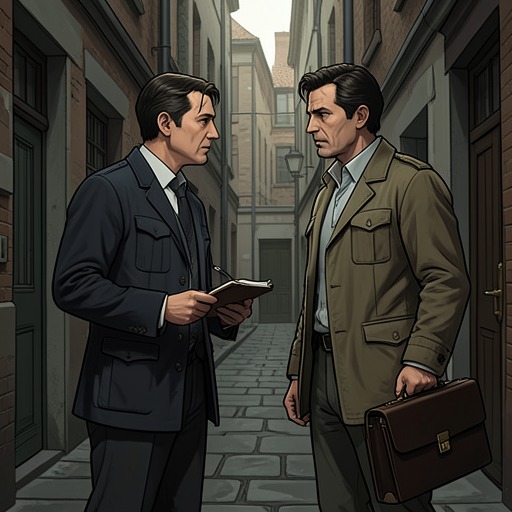
The brotherhood is not simply harmonious descent. In a compact exchange, Shem and Shaun are joined to “the shame that sunders em”: the phrase makes their bond inseparable from the fracture it contains. They are also figured as “Wisdom’s son, folly’s brother,” a paired contrast that assigns complementary positions without dissolving their difference.
Elsewhere, the brothers’ names surface amid accusations and competing accounts of HCE. A public ballad turns identity into a chorus of alternative names, finally fastening on Persse O’Reilly, while a crowd’s refrains make the subject both recognizable and unstable. In another passage, witnesses and commentators offer conflicting explanations of the alleged encounter involving HCE, including the claim that his first seduction was proposed by a woman. Such episodes do not establish a specific action by either brother; instead, they place the family story within a wider world where reputation is produced through rival voices and uncertain testimony.
Public Voices and Family Story
The brothers’ relation appears in a book crowded with speech forms that compete for authority. A narrator recounts an encounter in the park through HCE’s reported defense, while the account itself presents that defense as reconstructed from successive tellings. Elsewhere, a dustman, a driver, a detective, and other observers give sharply different opinions about HCE and the accusations surrounding him. The family’s public image therefore reaches the reader through gossip, testimony, legal language, and comic performance rather than through a single authoritative report.
The ballad episode sharpens this instability. Hosty’s song is performed as a communal event, with refrains and a list of names that crowd around the person being identified. The scene makes public naming an action in its own right: a reputation is circulated, varied, and amplified by collective voices. The brothers’ larger family identity is subject to the same pressure of retelling, though the ballad passage does not assign the brothers a distinct role in its performance.
A Relation Made of Opposites
The text’s brief formula of “Three in one, one and three” gathers Shem and Shaun into a paradoxical unity, then immediately marks the shame that separates them. Their brotherhood can thus be read as a structure of paired oppositions: wisdom and folly, kinship and estrangement, shared origin and divergent identity. The formula does not resolve the conflict; it gives the conflict a compact verbal shape.
That doubleness also connects the family relation to the book’s recurring transformations of names and voices. The brothers are invoked alongside questions about parentage, shifting designations, and public accounts that cannot be made to agree. Their bond remains consequential precisely because it is never reduced to one stable description: it is at once inheritance, rivalry, and a repeated figure for difference held within a shared whole.